Resources
Fairly complete, always tweaking ; ) ...
SECTIONS
1. Registration Information
2a. Code of Conduct
2b. Swim Parent's Role
3. Practice Policies & Information
4. Swimmer 101 : Suits, Food, Health
5. Swim 101 : Terms & Strokes
6. Swim Meets 101 : including needs, what to know's
7. Swim Meet Volunteering
uc8. Other Events
9. Coaching Positions
uc10. Swim Lessons & Year-Round Swim Teams


1. REGISTRATION INFORMATION
2025 per Swimmer Pricing:
1st Child > $165
2nd Child > $140
3rd Child > $115
4th Child + > $100
Mini-Marlin > $175 - see Mini-Marlins detailed note below
15 & Overs > $60
Non-Resident Fee > $30 per family
ASA League Fees > $42.00 for each swimmer including mini's
ASA Late Fees > The ASA fees increase to $62.00 on April 16th,2024 then $67.00 on June -nd, 2025.
>>> Mini-Marlin detail: Swimmers 6 and under who cannot yet swim one lap but are able to swim at least 5 yards unassisted. They will be fully assisted and guided during lessons. This group will swim at select meets but not in a competitive format. The swimmer can move up to the competitive 6 & under age group during the season if they reach the necessary swim level to compete safely.
New in 2023: There has been a change to this year's required fee policy - due to the needs of the ASA to properly ensure each team's summer league swimmers, the ASA has added a fee for each non-competitive swimmer (Mini-Marlins). we lowered our Mini-Marlin per swimmer fee to absorb some of this expense.
Availability:
Roster spots are based on availability which is determined by group size to assure safety and attention to the swimmers. If an age group reaches its limit a wait list will be established for those registering afterward. A full refund will be issued it these swimmers paid and are not placed on the team.
Marlins Refund Policy:
Up until the first practice, 100% minus $35 is refundable. Up until the first meet, 50% minus $35 is refundable. 0% is refundable after first meet. Any refund must be requested in writing or via email.
2a. CODE OF CONDUCT
PARENT & SWIMMER CODE OF CONDUCT
As a member of the Longlake Marlin Swim Team you are part of an exciting tradition of having fun with teammates while learning swim skills and competing as a team. This is an inclusive swim team focused on fun and competition in a safe and rewarding atmosphere for all. Along with this comes responsibility to represent your team well and make your best effort to have a positive influence on the team.
Swimmers:
- While training and competing, exhibit behaviors exemplifying teamwork, respect, integrity, and sportsmanship.
- Our coaches and team management have a wealth of swim team experience, they will be teaching you swim stroke skills, swim competition knowledge, safety, and some important life skills; be sure to be disciplined by not interrupting your coaches, following their directions, being respectful of their authority and experience, being on time and trying to keep your focus, helping when possible, and always showing good sportsmanship towards your teammates no matter what their swimming skill level may be.
- Do your best to be present and on time at every practice, meet, or other team function and actively participate. Remember, you are part of a team and your efforts can effect more than just yourself.
- Take pride in representing the Marlins at all team functions. Know that people are watching and your actions represent the team and community.
- Be sure to show respect to team management, meet management, and volunteers. This includes being where you are supposed to be for your bullpen manager, deck manager, and coaches. Ask questions if you’re not sure what the meet process is so you know what you must do. Don’t argue with swim officials for any reason – bring up any concerns with your coaches.
- Always show sportsmanship and courtesy to all your teammates and members of other teams.
- Win or lose graciously and respectfully.
- Wear the appropriate team swimsuit and cap at all meets.
- Read and understand all posted Longlake Pool rules.
- Do not use any equipment in any inappropriate or destructive manner including staying off the lane lines except when using in normal course of swimming assistance.
- No running, inappropriate jumping, pushing, dunking, or roughhousing in pool area or surrounding areas. This includes when in public areas outside your practice times. If any age group of the Longlake Marlins is participating in a team practice then all members of the Longlake Marlins are to be showing respect to their teammates and coaches.
- The following are absolutely prohibited and will likely result in team removal for any occurrence:
- Alcohol, tobacco, prohibited substances, vaping
- Violence, threats, inappropriate touching or conduct
- Abusive language, offensive terms or reference, bullying
- Dishonesty with malicious intent
These rules go beyond in person to any social platforms or communication forums.
Parents:
- Read through the swimmer’s code of conduct with your swimmers and be sure they understand all expectations. Be sure your swimmer(s) understand the Longlake Pool Rules.
- Adhere to all the prohibited behaviors that are listed for the swimmers.
- Set the example for our swimmers by showing respect and courtesy to our team members, coaches, team management, competitors, vendors, and officials.
- Assume coaches and officials base decisions on honesty and their best judgement with what information they have available. Take any issues with officials to coaches or team management and any issues with coaches to the Team Director.
- Demonstrate good sportsmanship during all practices, meets, and team functions.
- Be responsible for your swimmer(s) arriving on time and prepared to all team functions with any required gear such as team swimsuit and cap.
- Be respectful of your swimmer(s) being a member of a team and avoid missing any meets if at all possible. Any time your swimmer will be late or absent, let the coaching staff know as soon as possible.
- Follow all protocol and requests for meet attendance, volunteering, parking, and other team needs.
- Be on time for all volunteering commitments.
- Do not leave a meet before it’s completed without discussing with Head Coach. Do not rely on random information during rain delays - All decisions and updates will come from Team Director and Head Coach.
- Remember that the parents are also representing the team when they are attending team functions.
- Photographs and videos will be taken of your swimmer(s) throughout the season. These photos will be used only by the Longlake Marlins for purposes of creating and sharing a record of events and for some marketing of team through social media or pitch based collateral. Signing this section authorizes approval of this usage.
By checking the agreement box you and your swimmer(s) agree to abide by the Longlake Marlins Code of Conduct.
2b. A Swim Parent's Role
A Swim Parent’s Role
3. Practice Information
Please click on the Practice Tab in the above Navigation Menu for detailed information on Practice details and policies.
4. SWIMMER 101 : Suits, Food, Health
Swim Suits- solid black swimsuits with Marlins logo are mandatory. You will need to purchase a solid black jammer for boys or a girl's one-piece suit at establishments such as Swim Atlanta swim shop, Academy Sports, www.swimoutlet.com, Lands End, Amazon - just to name a few places. To get the Longlake Marlins logo embroidery, please drop swim suits off at the Longlake Pool starting the first day of practice (look for a storage bin labeled embroidery). Place the swimsuit with $10 cash inside of a ziplock bag with your swimmers name and a phone number on the swimsuit tag and the ziplock bag. Deadline to turn in suit is May 20th. Lidia Lachonkova, owner of Embroidery And More, requests a May 20 deadline for orders to be processed in time for our first meet.
If you have questions, please email us at [email protected].
--------------------------------------------------------------------------------------------------------
Two articles on Healthy Eating for Swimmers including meet recommendations:
Healthy Meals for Swimmers on the Go Notes on BREAKFAST - Start your day off right! Try pancakes, waffles, french toast, bagels, cereal, English muffins, fruit or juice. These foods are all high in carbohydrates. Avoid high-fat choices such as bacon, sausage or biscuits and gravy. For breakfast on the run, pack containers of dry cereal, crackers, juice or dried fruit such as raisins and apricots; or pack fresh fruits such as apples or oranges. If you eat breakfast at a fast food restaurant choose foods like cereal, fruit juice and muffins or pancakes. Avoid breakfast sandwiches, sausage and bacon.
EXAMPLES OF HIGH CARBOHYDRATE BREAKFAST MEALS:
At Home: Orange juice, Fresh fruit, Low-fat yogurt, Pancakes with syrup, 2% or skim milk or Plain English muffin, Strawberry jam, Scrambled Egg, Orange juice, 2% or skim milk
At a Fast Food Restaurant: Hot cakes with syrup (hold the margarine and sausage), Orange juice, Low-fat milk or Cold cereal with low-fat milk, Orange juice, Apple, bran or blueberry muffin
At a Convenience/ Grocery Store: Fruit flavored yogurt, Large bran muffin or pre-packaged muffins, Banana, Orange juice, Low-fat milk
At a Family Style Restaurant: Pancakes, waffles or french toast with syrup (hold the margarine, bacon and sausage), Orange juice, Low-fat milk
Notes on LUNCH and DINNER Select pastas, breads and salads. Select thick crust rather than thin crust pizza for more carbohydrates. Choose vegetables such as mushrooms and green peppers on the pizza. Avoid high fat toppings such as pepperoni and sausage. Select vegetable soups accompanied by crackers, bread, or muffins. Emphasize the bread in sandwiches, not the condiments, mayonnaise or potato chips. Avoid deep fat fried foods such as french fries, fried fish and fried chicken. Choose low-fat milk or fruit juices rather than soda pop.
>>>>>>>>>>>>>>>>>>>>>
10 NUTRITION STRATEGIES FOR SWIM MEETS
At the end of the season when you’re laying everything on the line, don’t let a misstep in nutrition or poor planning sabotage your goals. Here are a few things to keep in mind as you prepare for the biggest meet of the season:
1. Eat breakfast. Start races on the right foot by eating something first thing in the morning. Muscles and metabolism will get the carbohydrate and energy boost they need.
+++++++++++++++++++++++++++++++++++++++++++++++++++++++++++
5 Tips to Prevent Swimmer's Ear
By
:max_bytes(150000):strip_icc():format(webp)/KristinHayes-1000-1a35767549884928b0dd90a19a2be0ed.jpg) Updated on April 18, 2022
Updated on April 18, 2022
Germs that require a moist environment to survive can cause swimmer's ear. So if your ears are dry the germs cannot grow. Swimmers' ear is an outer ear infection that develops when contaminated water sits in the ear for a prolonged period of time.
It's a common infection that can be very painful, but it can be prevented. Around 10% of people will experience swimmer's ear at some point during their life, but research shows that appropriate treatment and management is effective and can help avoid potential complications.
The following tips can help you prevent swimmer's ear.
:max_bytes(150000):strip_icc():format(webp)/can-i-prevent-swimmers-ear-1192235-4ac611527fa043fcb7f0f2b3ef71ec25.jpg)
Verywell / Brianna Gilmartin
Keep Your Ears Clean and Dry, Especially After Swimming
Thoroughly dry each ear canal after swimming or bathing. First, tip your head to the side until all of the water runs out of your ear, repeat on the other side. If necessary, you can carefully use a hairdryer on the coolest setting to completely dry the ear canal.
Some healthcare providers recommend mixing a drop of rubbing alcohol with a drop of vinegar and putting it in your ears after swimming or bathing to dry out the ear—particularly if you have had ongoing problems with swimmer's ear. However, if you do this too often, and the skin inside your ear canal gets chapped, it can increase your chances of getting an infection. Always talk to your healthcare provider before you try this or any other home remedy.
Always Maintain Proper Ear Wax Hygiene
Ear wax (also called cerumen) plays an important role in preventing ear infections. Too much or too little ear wax can cause problems.
Using improper cleaning methods such as ear candling can damage the ear canal and make it more prone to infection.
Plus, ear wax repels water.
Wear Earplugs While Swimming
Wearing earplugs that keep water out of the ears while swimming or bathing can help prevent swimmer's ear. Pliable earplugs can be purchased at some healthcare provider's offices or at many stores. Just make sure you get earplugs that fit properly and are intended to keep water out of the ear, (versus foam earplugs sold to keep noise out or equalize ear pressure).
Always Take Good Care of Your Skin
The integrity of the skin inside the ear canal plays a big role in preventing swimmer's ear. Cracked, dry, or otherwise impaired skin is an infection waiting to happen.
You may be more likely to get swimmer's ear if you have a condition such as eczema, allergies, or seborrhea.
Make sure these conditions are treated by a healthcare provider. Even if you don't have these conditions it's possible to have dry, itchy ears with flaky skin. Some tips for keeping this under control include:
- Avoid vigorous cleaning of the ear. If you have excessive ear wax, get your ears professionally cleaned by a healthcare provider. Because you may have small abrasions after having your ears irrigated by a healthcare provider, don't go swimming or get in a hot tub for a couple weeks.
- Keep your ears dry.
- Avoid scratching or cutting your ears.
- Never insert a Q-tip or any other objects in your ears, which may damage the skin.
- Keep hairspray or other irritating chemicals out of the ears by using earplugs or cotton balls.
- You may use a drop or two of vegetable oil or olive oil in your ears each day to help lubricate the ear canal and nourish dry skin.
Consider Using Ear Drops
There are a few ear drops you can use to help prevent swimmer's ear. But, if you suspect you may have a ruptured eardrum do not put anything in your ears and see a healthcare provider as soon as possible.
You should also avoid using ear drops if you have synthetic ear tubes, or if you have had any recent ear surgery.
If you don't have any of the conditions listed above, the following ear drops may be used:
- Rubbing alcohol: Evaporates water trapped inside the ear and has antimicrobial properties. Use a few drops in each ear after swimming or getting in a hot tub. Overuse can cause dry chapped skin.
- White Vinegar: Affects the pH inside of the ear canal. Many healthcare providers recommend mixing a solution of half vinegar and half rubbing alcohol and using a few drops in each ear after swimming or bathing.
- Olive Oil: A few drops a day lubricates dry itchy skin and repels water. It has also been claimed that a little bit of olive oil can help people with excessive ear wax naturally expel cerumen.
- Hydrogen Peroxide: We mention hydrogen peroxide because it's listed on many websites as a home remedy for swimmer's ear. While hydrogen peroxide does have the ability to kill a wide range of germs, it may also kill your healthy tissue cells as well. For this reason, it has fallen out of favor with many healthcare professionals. When healthcare providers do use hydrogen peroxide, they often recommend diluting it or rinsing it off with saline or sterile water about 30 seconds after application.
Ear drops are best applied with the help of another person. Lay down on your side so that your ear is facing up. Have them pull your ear slightly out and up to straighten out the ear canal, then put in a few drops. Continue to lay on your side for a few minutes after the drops go in to make sure they are absorbed.
It should be noted that any kind of ear blockage will make drops virtually useless. If you have excessive ear wax, drops will work best soon after your healthcare provider has cleaned your ears out. However, avoid using drops immediately afterward as you may have small cuts or abrasions inside the ear canal. Do not try to remove ear wax yourself and don't use a Q-tip. You will most likely just pack the ear wax in and make it even harder for the drops to absorb.
Complete Treatment to Avoid Recurrence
The best way to avoid getting another case of swimmer's ear is to finish your entire course of antibiotics.
Stopping antibiotics too soon can result in drug-resistant superbugs. Your infection might not just come back, but could be even harder to treat.
Once you have finished treatment and been cleared by your healthcare provider, follow the tips listed above to prevent swimmer's ear in the future.
5. SWIM 101 : Terms & Strokes
Swim Terms / Definitions >
Alternate: In a Prelims/Finals meet, after the finalists are decided, the next two fastest swimmers other than the finalists are designated as alternates. The faster of the two being the first alternate and the next being second alternate. If a finalist cannot participate, the alternates are called to take their place.
Anchor: The final swimmer in a relay. Also a term coaches use for the beginning of all four strokes indicating the “high elbow”, “catch,” or “early vertical forearm.”
Backstroke: A swimming stroke executed on the back and usually consists of alternating circular arm pulls and a flutter kick. Backstroke is also known as the back crawl.
Bilateral Breathing – Breathing on both sides of your body while you are swimming creates smooth, even strokes. You get a better balance in the water by alternating your breathing and you develop uniform muscles. Breathing to both sides of your body becomes even more important when you move from the pool to the open water.
Blocks: The starting platforms located behind each lane from where the swimmer dives in to start the race. Minimum water depth for use of starting blocks is 4 feet. Blocks have a variety of designs and can be permanent or removable.
Breaststroke: Breaststroke is a swimming style in which the swimmer is on their chest and the torso does not rotate. It is the most popular recreational style due to the swimmer’s head being out of the water a large portion of the time, and that it can be swum comfortably at slow speeds. Breaststrokers’ arms and legs work together at the same time, in the pull-breathe–kick-glide sequence. Timing is crucial for breaststroke swimming.
Butterfly: – A swimming stroke in which the arms are thrown forward together out of the water while the feet kick up and down. The arms move simultaneously in an hourglass shape and the legs do the dolphin kick.
Cap: Latex or lycra head covering used during a race or workout to protect a swimmer's hair from the effects of chlorine; also serves to eliminate drag from a swimmer's hair.
Catch phase: The beginning part of the stroke where the arms and hands start to propel the body.
Check-In: The procedure required before a swimmer swims an event in a deck-seeded meet. Sometimes referred to as positive check-in, the swimmer must mark their name on a list posted by the meet host.
Circle Swim – When sharing a lap lane with another person, the practice of swimming in a rotational pattern – like a long oval – is known as circle swimming. That means you go down the length of the pool to the right of the black line, and swim back on the left of it.
Command: On the long whistle from the referee, swimmers step onto the starting platform or, in the case of the backstroke and medley relay races, enter the water. On the starter's command — "take your mark" — swimmers immediately take a starting position, with at least one foot at the front of the starting platform. When all swimmers are stationary, the starter gives the starting signal.
Deck Entries: Accepting entries into swimming events on the first day or later day of a meet.
Deck Seeding: Heat and lane assignments are posted after swimmers have checked in have “scratched” (indicated they will not participate in the event.)
Designated distance (length of pool) for swimming competition. (Ie) Long Course = 50 meters / Short Course = 25 yards or 25 meters.
Disqualified: A swimmer's performance is not counted because of a rules infraction. A disqualification is shown by an official raising one arm with open hand above their head.
Dolphin kick: Used in the butterfly, and during underwater portions of freestyle and backstroke races, where the thrust of the kick comes from the hips, and the feet and legs are held together.
Drafting: A maneuver in which one swimmer is just behind another in an adjacent lane and uses the fast-moving water generated by their opponent to overtake the competitor. A memorable example of drafting is Jason Lezak's anchor leg in the men's 4x100m freestyle relay from the 2008 Beijing Games.
Drag suit: A second, loose-fitting suit worn in workouts and warm-ups to add weight and resistance. The concept is similar to a baseball player swinging two or three bats in the on-deck circle.
Dryland: The exercises and various strength programs swimmers do out of the water.
Entry: An individual, relay team, or club roster's event list in a swim competition.
Entry Limit: Each meet will usually have a limit of total swimmers they can accept, or a time limit they cannot exceed. Once an entry limit has been reached, a meet will be closed and all other entries returned.
Electronic Timing: Timing system operated on DC current (battery). The timing system usually has touchpads in the water, junction boxes on the deck with hook up cables, buttons for backup timing, and a computer-type console that prints out the results of each race. Some systems are hooked up to a scoreboard that displays swimmers.
Event: A race or stroke over a given distance. An event equals 1 preliminary with its final, or 1 timed final.
Exchange: Occurs during relays when one swimmer touches the wall and the next swimmer dives in. Relay exchanges are often where false starts occur, as swimmers on the blocks are looking for an edge and accidentally dive in before the previous swimmer touches the wall. A swimmer can leave the blocks up to .03 of a second before the previous swimmer touches the wall, but the team is disqualified if a swimmer leaves any time earlier that.
False start: Occurs when a swimmer either leaves the starting block or is moving on the block before the starter officially starts the race. Since 1998, there has been no warning false start. Any swimmer starting before the starting signal will be disqualified. If the starting signal sounds before the disqualification is declared, the race will continue, and the swimmer(s) will be disqualified upon completion of the race.
False Start Rope: A recall rope across the width of the racing pool for the purpose of stopping swimmers who were not aware of a false start. The rope is about 1/2 way on yard pools and about 50 feet from the starting end on meter pools.
Final: The last race of an event and the one in which medalists are determined. Typically, a final comprises the eight fastest swimmers from two preceding, semifinal races.
Fins: Large rubber flipper-type devices that fit on a swimmers feet. Used in swim practice, not competition.
Flags: Hanging flags placed above the pool five meters from each wall. They enable backstrokers to execute a turn more efficiently by providing a mark by which to count their strokes.
Flat start: Refers to the start of a race, where the swimmer stands still on the blocks and waits for the starter's signal, as opposed to a relay start via an exchange. A flat start is considerably slower than a relay start.
Flip turn: Used in freestyle and backstroke races, where swimmers somersault before reaching the wall and push off with their feet, never touching the wall with their hands.
Flutter Kick: a brisk, alternating, up-and-down movement of the legs when swimming with certain strokes, such as the crawl. The kick should originate from the hips, with the rest of the leg relaxed and following the hip motion.
Flip Turn: A technique used by swimmers to change direction when the end of the lane is reached. Flip turns are used for front and back crawl.
Freestyle: Freestyle means that in an event so designated the swimmer may swim any style, except that in individual medley or medley relay events, freestyle means any style other than backstroke, breaststroke, or butterfly. Most swimmers choose to swim front crawl for freestyle events.
Front Crawl: a style of swimming in which the swimmer faces downwards and moves their arms alternately in strokes, breathing to the side and using the flutter kick
Glide: Gliding while swimming happens before a stroke begins, between strokes, after a flip turn or at the end of a lap. Proper gliding technique allows a swimmer to maintain momentum while preparing for the next stroke. Body positioning varies depending on the circumstance.
Goggles: Eyewear worn in the pool to protect swimmers' eyes from the effects of chlorine. In the past, swimmers used saliva or wiped a cigarette on the inside of their goggles to prevent them from fogging up mid-race. Today's goggles are fogless, fit better and even come with polarized lenses to cut down on outdoor glare. This innovation is particularly helpful to backstrokers, who used to go "sun blind" swimming outdoors.
Gravity wave: Wave action caused by the bodies moving through the water. Gravity waves move down and forward from the swimmer, bounce off the bottom of the pool and return to the surface in the form of turbulence.
Gutter: The area at the edges of the pool into which
water overflows during a race; the water is then re-circulated into the pool.
Deep gutters catch surface waves and don't allow them to wash back into the
pool and affect the race.
Heat: A grouping of swimmers assembled to compete in
a race. Most often used to refer to the individual races of the
preliminary round of competition, though the term can apply to semifinals
and finals as well.
IM: Abbreviated term for individual medley, an event in which the
swimmer uses all four competitive strokes in the following order: butterfly,
backstroke, breaststroke, freestyle.
Jump: An illegal start done by the 2nd, 3rd, or 4th member of a relay team. The swimmer on the block breaks contact with the block before the swimmer in the water touches the wall.
Kick Board: A flotation device used by swimmers during practice.
Lane: The specific area in which a swimmer is assigned to swim. (ie) Lane 1.
Lane lines: The dividers used to create lanes. These are made of individual finned discs that are strung on a cable and rotate when hit by a wave. The rotating discs dissipate surface-tension waves in a competitive pool.
Lap: One length of the pool. A 100m race (down and back) is two laps.
Lap Swimming: Lap swim is designed for more organized swimming up and down the length of the pool repeatedly. This is how the pool is set up for competitive swim practice and meets, or for people who are exercising on their own.
Leg: The part of a relay event swum by a single team member. A single stroke in the IM.
Long course: A term used to describe a pool in which one length measures 50 meters. The Olympic Games are conducted at long-course venues.
Marshall: The official who control the crowd and swimmer-flow at a swim meet.
Meet: A series of events held in one program.
Meet Director: The official in charge of the administration of the meet. The person directing the "dry side" of the meet.
Meters: The measurement of the length of a swimming pool that was built per specs using the metric system. Long course meters is 50 meters, short course meters is 25 meters.
Negative split: A race strategy in which a competitor swims the second half faster than the first.
Official: A judge on the deck of the pool. Various judges watch the swimmers' strokes, turns and finishes. Some officials are timers.
Paddle: Colored plastic devices worn on the swimmers hands during swim practice.
Positive Check In: The procedure required before a swimmer swims an event in a deck seeded or pre seeded meet. The swimmer or coach must indicate the swimmer is present and will compete.
Practice: The scheduled workouts swimmers attend with their swim team/club.
Prelims: Short for preliminaries, which describes the round of races in which competitors try to qualify for the semifinals (or final, in events without semifinals). Also called heats.
Psyche Sheet: An entry sheet showing all swimmers entered into each individual event. Sometimes referred to as a "Heat Sheet" or meet program. However, a “heat sheet” would show not only every swimmer in an event, but also what heat and lane they are swimming in.
Pullout or pulldown: The beginning of a breaststroke start or turn, where a swimmer is allowed one long pull down to their waist, during which a single butterfly kick is permitted, followed by a breaststroke kick.
Qualifying Times: Published times necessary to enter certain meets, or the times necessary to achieve a specific category of swimmer. See "A", "AA" (etc.) times.
Reaction time: The time it takes for a swimmer to leave the blocks after the starter gives the signal. Modern timing systems are equipped with sensors that mark the time elapsed, which is generally less than one second. In relays, reaction time for the second, third and fourth legs are measured from when the swimmer in the water touches the wall to when the next swimmer leaves the blocks.
Recovery phase: The conclusion of the stroke where the hand and arms finish pulling and set up to start the next stroke cycle.
Referee: The head official at a swim meet in charge of all of the "Wet Side" administration and decisions.
Relays: A swimming event in which four swimmers participate as a team. Each swimmer completes an equal distance of the race. There are two types of relays: 1.) Medley relay - One swimmer swims Backstroke, one swimmer swims Breaststroke, one swimmer swims Butterfly, one swimmer swims Freestyle, in that order.
Relay start: Refers to the second, third and fourth swimmers in a relay, where they dive in when the previous swimmer touches the wall. Relay starts are faster than flat starts, because swimmers can anticipate when they can dive in, and they are allowed to leave the blocks up to .03 of a second before the previous swimmer touches.
Roll: To move on the starting blocks prior to the starting signal. A roll is usually caught by the starter and called a false start, but swimmers will often try to guess the starter's cadence and get a good start. Similar to a false start infraction in football.
Scratch: To withdraw from an event in a competition.
Short course: A term used to describe a pool in which one length measures 25 meters (or 25 yards). Most college pools are short-course yards, and most events during the winter are held at short-course venues. The Olympics are held in long course (50m) pools.
Split: The time registered by a swimmer when he or she finishes each length of the pool. Splits can be used to show which segment of a race a swimmer covered in noteworthy time, to indicate rank order after each 50m increment, and to convey whether a swimmer is matching a notable record's pace. Also, split can refer to the time a relay swimmer takes to complete his/her leg of the race.
Sprint: Refers to short intense swims of usually not more than 100 meters.
Start: The beginning of a race. The dive used to begin a race.
Starter: The official in charge of signaling the beginning of a race and insuring that all swimmers have a fair takeoff.
Stand-up: The command given by the Starter or Referee to release the swimmers from their starting position.
Step-Down: The command given by the Starter or Referee to have the swimmers move off the blocks. Usually this command is a good indication everything is not right for the race to start.
Stroke: There are 4 competitive strokes: Butterfly, Backstroke, Breaststroke, Freestyle.
Stroke Judge: The official positioned at the side of the pool, walking the length of the course as the swimmers race. If the Stroke Judge sees something illegal, they report to the referee and the swimmer may be disqualified.
Submitted Time: Times used to enter swimmers in meets. These times must have been achieved by the swimmer at previous meets.
Swim-off: In a Prelims/Finals type competition, a race after the scheduled event to break a tie. The only circumstance that warrants a swim-off is to determine which swimmer makes finals or an alternate, otherwise ties stand.
Taper: The gradual process of resting in preparation for competition. During the middle of the swimming season, a swimmer might work out 10,000 to 15,000 meters (8 to 10 miles) each day. As a major competition draws near, the swimmer will "taper" off the distances each day. A perfectly designed taper will enable the swimmer to compete at the peak of his/her ability.
Team Records: The statistics a team keeps, listing the fastest swimmer in the clubs history for each age group/each event.
Timed Finals: Competition in which only heats are swum and final placings are determined by those times.
Timer: The volunteers sitting behind the starting blocks/finish end of pool, who are responsible for getting watch times on events and activating the backup buttons for the timing system.
Time Trial: An event or series of events where a swimmer may achieve or better a required time standard.
Touch: The finish of the race.
Touchpad: The area at the end of each lane in the pool where a swimmer's time is registered and electronically sent to the timing system, which sends the time to the scoreboard.
Track start: Position on the starting blocks where the swimmer places one foot at the front of the block and one foot farther back.
Turnover: The number of times a swimmer's arms turn over (cycle) in a given distance or time during a race.
Unofficial Time: The time displayed on a read out board or read over the intercom by the announcer immediately after the race. After the time has been checked, it will become the official time.
USA Swimming: The national governing body of the sport headquartered in Colorado Springs.
Warm-down: Additional swimming or activity used by a swimmer to rid the body of excess lactic acid generated during a race. Also called "cool-down."
Warm-up: Additional swimming or activity used by a swimmer in preparation shortly before a race.
Yardage: The distance a swimmer races or swims in practice. Total yardage can be calculated for each practice session.
Some selections of the terms list taken from nbcolympics.com, Teamunify.com, and © Elite Sports Clubs websites.
>>>>>>>>>>>>>>>>>>>>>>>>>
UNITED STATES SWIMMING TECHNICAL RULES (Rev. 4/1/19)
101.1 STARTS
1.Equipment — A loudspeaker start system conforming to 103.18, with or without an underwater recall device, and an electronic strobe signal visible to all manual timers for forward
and backstroke starts, shall be the preferred starting device.
2.The Start
A.At the commencement of each heat, the Referee shall signal to the swimmers by a short series of whistles or the verbal instruction “STEP UP” to remove all clothing except for swimwear, followed by a long whistle indicating that they should take and maintain their positions on the starting platform, the deck, or in the water. In backstroke and medley relay events, at the Referee’s first long whistle or the instruction “STEP IN”, the swimmers shall immediately enter the water and at the second long whistle shall return without undue delay to the starting position.
B. When the swimmers and officials are ready, the Referee shall signal with an outstretched arm to the Starter that the swimmers are under the Starter’s control.
C.On the Starter’s command “take your mark”, the swimmers shall immediately assume their starting position, in the forward start, with at least one foot at the front of the starting platform or the deck. Swimmers starting in the water must have at least one hand in contact with the wall or starting platform. When all swimmers are stationary, the Starter shall give the starting signal.
D.When a swimmer does not respond promptly to the command "take your mark," the Starter shall immediately release all swimmers with the command "stand up" upon which the swimmers may stand up or step off the blocks.
E.A swimmer shall not be disqualified for an illegal starting position at the start if the race is permitted to proceed. Enforcement of the correct starting position is the responsibility of the Starter.
3.False Starts
A.Any swimmer starting before the starting signal is given shall be disqualified if the Referee independently observes and confirms the Starter’s observation that a violation occurred. Swimmers remaining on the starting blocks shall be relieved from their starting positions with the "stand up" command and may step off the blocks.
B.If the starting signal has been given before the disqualification is declared, the race shall continue without recall. If the Referee independently observes and confirms the Starter’s observation that a violation occurred, the swimmer or swimmers who have false started shall be disqualified upon completion of the race.
C.If the recall signal is activated inadvertently, no swimmer shall be charged with a false start and the Starter shall restart the race upon signal by the Referee.
D.A swimmer who would otherwise be charged with a false start may be relieved of the charge if the false start was caused by the swimmer’s reaction to the “stand up” command.
4.Deliberate Delay or Misconduct
A. The Starter shall report a swimmer to the Referee for delaying the start, for willfully disobeying an order or for any other misconduct taking place at the start, but only the Referee may disqualify a swimmer for such delay, willful disobedience or misconduct.
B.The Referee shall disqualify a swimmer who fails to appear at the starting platform ready to swim in time for the initial start of his/her heat.
C.Such disqualification shall not be charged as a false start.
101.2 BREASTSTROKE .
1Start — The forward start shall be used. .
2Stroke — After the start and after each turn when the swimmer leaves the wall, the body shall be kept on the breast. It is not permitted to roll onto the back at any time except at the turn after the touch of the wall where it is permissible to turn in any manner as long as the body is on the breast when leaving the wall. Throughout the race the stroke cycle must be one arm stroke and one leg kick in that order. All movements of the arms shall be simultaneous and in the same horizontal plane without alternating movement. The hands shall be pushed forward together from the breast on, under, or over the water. The elbows shall be under water except for the final stroke before the turn, during the turn and for the final stroke at the finish. The hands shall be brought back on or under the surface of the water. The hands shall not be brought back beyond the hip line, except during the first stroke after the start and each turn. During each complete cycle, some part of the swimmer’s head shall break the surface of the water. After the start and after each turn, the swimmer may take one arm stroke completely back to the legs. The head must break the surface of the water before the hands turn inward at the widest part of the second stroke.
3Kick — After the start and each turn, at any time prior to the first breaststroke kick a single butterfly kick is permitted. Following which, all movements of the legs shall be simultaneous and in the same horizontal plane without alternating movement. The feet must be turned outwards during the propulsive part of the kick. Scissors, alternating movements or downward butterfly kicks are not permitted except as provided herein. Breaking the surface of the water with the feet is allowed unless followed by a downward butterfly kick.
4Turns and Finish — At each turn and at the finish of the race, the touch shall be made with both hands separated and simultaneously at, above, or below the water level. At the last stroke before the turn and at the finish an arm stroke not followed by a leg kick is permitted. The head may be submerged after the last arm pull prior to the touch, provided it breaks the surface of the water at some point during the last complete or incomplete cycle preceding the touch.
101.3 BUTTERFLY .
1.Start — The forward start shall be used.
2.Stroke — After the start and after each turn, the swimmer’s shoulders must be at or past the vertical toward the breast. The swimmer is permitted one or more leg kicks, but only one arm pull under water, which must bring the swimmer to the surface. It shall be permissible for a swimmer to be completely submerged for a distance of not more than 15 meters (16.4 yards) after the start and after each turn. By that point, the head must have broken the surface. The swimmer must remain on the surface until the next turn or finish. From the beginning of the first arm pull, the body shall be kept on the breast except at the turn after the touch of the wall where it is permissible to turn in any manner as long as the body is on the breast when leaving the wall. Both arms must be brought forward simultaneously over the water and pulled back simultaneously under the water throughout the race.
3.Kick — All up and down movements of the legs and feet must be simultaneous. The position of the legs or the feet need not be on the same level, but they shall not alternate in relation to each other. A scissors or breaststroke kicking movement is not permitted.
4.Turns — At each turn the body shall be on the breast. The touch shall be made with both hands separated and simultaneously at, above, or below the water surface. Once a touch has been made, the swimmer may turn in any manner desired. The shoulders must be at or past the vertical toward the breast when the swimmer leaves the wall.
5.Finish — At the finish, the body shall be on the breast and the touch shall be made with both hands separated and simultaneously at, above, or below the water surface.
101.4 BACKSTROKE .
1.Start — The swimmers shall line up in the water facing the starting end, with both hands placed on the gutter or on the starting grips. Standing in or on the gutter, placing the toes above the lip of the gutter, or bending the toes over the lip of the gutter, before or after the start, is prohibited. When using a backstroke ledge at the start, the toes of both feet must be in contact with the end wall or face of the touchpad. Bending the toes over the top of the touchpad is prohibited.
2.Stroke — The swimmer shall push off on his back and continue swimming on the back throughout the race. Some part of the swimmer must break the surface of the water throughout the race, except it is permissible for the swimmer to be completely submerged during the turn and for a distance of not more than 15 meters (16.4 yards) after the start and after each turn. By that point, the head must have broken the surface of the water.
3.Turns — Upon completion of each length, some part of the swimmer must touch the wall. During the turn the shoulders may be turned past the vertical toward the breast after which an immediate continuous single arm pull or immediate continuous simultaneous double arm pull may be used to initiate the turn. The swimmer must have returned to a position on the back upon leaving the wall.
4.Finish — Upon the finish of the race, the swimmer must touch the wall while on the back. 101.5
101.5 FREESTYLE
1.Start — The forward start shall be used.
2.Stroke — In an event designated freestyle, the swimmer may swim any style, except that in a medley relay or an individual medley event, freestyle means any style other than butterfly, breaststroke or backstroke. Some part of the swimmer must break the surface of the water throughout the race, except it shall be permissible for the swimmer to be completely submerged during the turn and for a distance of not more than 15 meters (16.4 yards) after the start and each turn. By that point the head must have broken the surface.
3.Turns — Upon completion of each length the swimmer must touch the wall.
4.Finish — The swimmer shall have finished the race when any part of his person touches the wall after completing the prescribed distance.
101.6 INDIVIDUAL MEDLEY —
1.The swimmer shall swim the prescribed distance in the following order: the first one-fourth, butterfly; the second one-fourth, backstroke; the third one-fourth, breaststroke; and the last one-fourth, freestyle. .
2.Start — The forward start shall be used.
3.Stroke — The stroke for each one-fourth of the designated distance shall follow the prescribed rules for that stroke, except in the freestyle, the swimmer must be on the breast except when executing a turn.
4.Turns
a.Intermediate turns within each stroke shall conform to the turn rules for that stroke, except that in the freestyle turn, the swimmer must return to the breast before any kick or stroke.
b.The turns when changing from one stroke to another shall conform to the finish rules for the stroke just completed, and shall be as follows:
i.Butterfly to Backstroke — The swimmer must touch as described in 101.3.5. Once a legal touch has been made, the swimmer may turn in any manner, but the shoulders must be at or past the vertical toward the back when the swimmer leaves the wall.
ii.Backstroke to Breaststroke — The swimmer must touch the wall while on the back. Once a legal touch has been made, the swimmer may turn in any manner but the shoulders must be at or past the vertical toward the breast when the swimmer leaves the wall and the prescribed breaststroke form must be attained prior to the first arm stroke.
iii.Breaststroke to Freestyle — The swimmer must touch as described in 101.2.4. Once a legal touch has been made, the swimmer may turn in any manner and must return to the breast before any kick or stroke.
5.Finish — The swimmer shall have finished the race when any part of his/her person touches the wall after the prescribed distance.
101.7 RELAYS
1.Freestyle Relay — Four swimmers on each team, each to swim one-fourth of the prescribed distance using any desired stroke(s). Freestyle finish rules apply.
2.Medley Relay — Four swimmers on each team, each to swim one-fourth of the prescribed distance in the following order: first, backstroke; second, breaststroke; third, butterfly; and fourth, freestyle. Rules pertaining to each stroke used as described in 101.6 (Individual Medley) shall govern where applicable. At the end of each leg, the finish rule for each stroke applies in each case.
3.Rules Pertaining to Relay Races
a.A No swimmer shall swim more than one leg in any relay event.
b.When automatic relay take-off judging is used, each swimmer must touch the touchplate or pad in his/her lane at the end of the course to have finished his/her leg of the relay race.
c.In relay races a swimmer other than the first swimmer shall not start until his/her teammate has concluded his/her leg.
d.Any relay team member and his/her relay team shall be disqualified from a race if a team member other than the swimmer designated to swim that leg enters the pool in the area where the race is being conducted before all swimmers of all teams have finished the race. Exception: When an in-the-water start is required or such start is approved by the Referee.
e.Each relay team member shall leave the water immediately upon finishing his/her leg, except the last member.
f.In relay races the team of a swimmer whose feet have lost touch with the starting platform (ground or deck) before his/her preceding teammate touches the wall shall be disqualified.
g.In relay races involving in-the-water starts, the team of a swimmer who has lost touch with the end of the course before his/her preceding teammate touches the wall shall be disqualified, unless the swimmer in default returns to the original starting point at the wall.
h.On relays, the second, third and fourth swimmers are prohibited from starting from the top of the adjustable back plate. A swimmer must have at least part of one foot in contact with the starting platform in front of the adjustable back plate during a relay exchange.
False Start: If the starter charges a false start in an event, the first false start will be charged to everyone in the heat. If a second false start is charged in an event, it will be charged only to the individual(s) false starting and that (those) individual(s) will be disqualified and not permitted to swim that event. False starts in the League Championship will be charged to the individual and not the field.
6. SWIM MEET 101
Preparing for your first swim meet or it's been a while and you need a refresher - this is your guide >
WHAT TO BRING TO A SWIM MEET:
- Team swim suit.
- Goggles (plus backup goggles would be a good idea).
- At least 2 towels.
- Something comfortable to sit on (another towel usually works best or an older blanket).
-
Clothing considerations -
- big gap between swims? May want a coverup
- many meets end at night, get cold easy? May want something to stay warm
- need to get out of wet bathing suit? Don't forget that change of clothes.
- Sandals, water shoes, deck shoes - something that won't slip on pool deck.
- Some basic waterproof first aid supplies. The meet pools and teams will have First Aid Kits and Coaches with First Aid training but the kids may just need a quick clean and band aid cover of a small cut.
- Any medications or supplies for any specific medical concerns.
- Sun screen. Bug spray.
-
Something to do -
- first, consider the wet conditions and fairly limited space with many people walking around...
- Electronic devices (not usually the best idea, take precautions if bringing), cards, books, coloring books, etc.
- Try to avoid things like frisbees that spreads the group out making it hard to maintain control and find swimmers. It also tends to get rowdy and the swimmers use their energy chasing each other instead of using their energy to produce results they have trained hard to achieve.
-
Small cooler
- Healthy snacks
- Energy foods
- Plenty of water
- There will be concessions available at the meets.
- Be sure to check Swimmer 101 for nutrition suggestions.
- Sharpie (to mark / remark arm, details below)
- Be sure to label everything you bring!
- Parents - Depending on the sun location, shade, changing weather, hot deck area, etc --- during some meets you will go through significant changes, it's best to layer and come prepared for a variety of weather and temperature conditions.
- Parents - each pool has specific areas for the away team - it can be different each meet. We will do our best to inform you but we usually don't know the conditions of the exact area we are given ahead of time. Prepare as best you can - chairs, blankets, canopy's, a cooler, etc are all good things to have on stand-by.
- Parents - in addition to what's above, don't forget to keep your swimmer(s) well hydrated, keep yourself well hydrated, and along with other supplies bring some concessions money.
WHEN YOU ARRIVE:
- It's important to arrive on time!
- Swimmers should wear their swimsuit.
- Upon arrival the swimmer should check in at their bullpen (there will be a canopy setup in the designated Longlake swimmer area, it will be on the lakeside grassy area adjacent to the playground for home meets and an area assigned to us for the away meets. Each canopy will have the age group and girls/boys sign hanging so they know which canopy they will sit in. The swimmers are required to sit in this area for the meet, not with parents or any other location, but the parents can visit or even sit in this same area if they want)
- As soon as you arrive and the swimmer is checked in the parent volunteer needs to check in with the volunteer coordinator.
OTHER INFORMATION:
- Be sure you have the Swimtopia app downloaded to see swimmers times and results.
- Your swimmer(s) will have their arms marked during the Thursday morning practice with their swim information.
- The arm marking will look similar to this:
-
- How to Read Your Swimmers Arm:
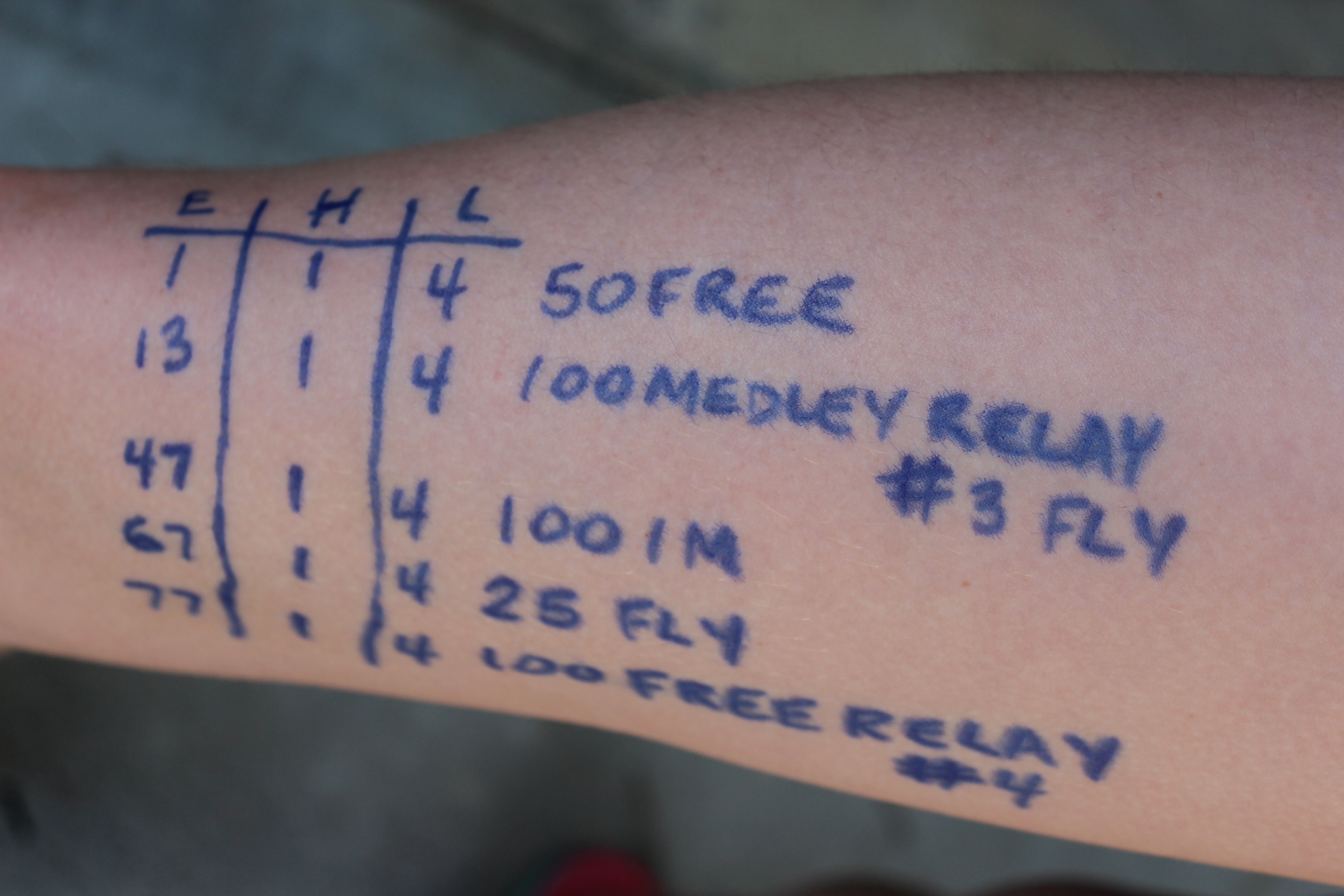
E H L
“E” is the event number .“H” is the heat number. “L” is the lane number.
“BK” means they swim the back stroke, “BR” means they swim breast stroke, “FR” means they swim freestyle, and “FLY” means they swim butterfly.
- The number of events your swimmer(s) will take part in varies by age, size of age group, skill level, and attendance. The example swimmers arm above has 5 events but not many swimmers will swim that many events, 3 or 4 is more typical.
- When we mark their arm at the end of each swimmer's morning practice session it usually is good come meet time but just do your best not to rub or smear it and you can always trace over it with a sharpie so it stands out and is clear for the meet.
- REMEMBER... to practice good teamwork and team support as outlined in the codes of conduct.
WHAT TO DO TO PREPARE BEFORE THE SWIM MEET:
- Declare your swimmer as attending by going to the Swimmer Meet Sign-in on the Meets & Events tab of the website.
- Sign-up for parent volunteering shifts, also on the Meets & Events section on website.
- Sign-up for Concessions Donations, also on the Meets & Events section on website.
- HYDRATE, HYDRATE, HYDRATE - Start this days in advance if it's not a regular practice.
- Read Meet Details email that will be sent a couple of days before the meet - it will share details on directions, where to park, what time to arrive, etc.
--------------------------------------------------------------------------------------------------------
ASA ORDER OF EVENTS — DUAL MEET
MEDLEY RELAY EVENTS
1. 6 & Under Girls 100 Free Relay
2. 6 & Under Boys 100 Free Relay
3. 7–8 Girls 100 Med. Relay
4. 7–8 Boys 100 Med. Relay
5. 9-10Girls 100 Med. Relay
6. 9-10 Boys 100 Med. Relay
7. 11-12 Girls 200 Med. Relay
8. 11-12 Boys 200 Med. Relay
9. 13-14 Girls 200 Med. Relay
10. 13-14 Boys 200 Med. Relay
11. 15-18 Girls 200 Med. Relay
12. 15-18 Boys 200 Med. Relay
FREESTYLE EVENTS
13. 6 & Under Girls 25 Freestyle
14. 6 & Under Boys 25 Freestyle
15. 7–8 Girls 25 Freestyle
16. 7-8 Boys 25 Freestyle
17. 9-10 Girls 25 Freestyle
18. 9-10 Boys 25 Freestyle
19. 11-12 Girls 50 Freestyle
20. 11-12 Boys 50 Freestyle
21. 13-14 Girls 50 Freestyle
22. 13-14 Boys 50 Freestyle
23. 15-18 Girls 50 Freestyle
24. 15-18 Boys 50 Freestyle
25. 7-8 Girls 50 Freestyle
26. 7-8 Boys 50 Freestyle
27. 9-10 Girls 50 Freestyle
28. 9-10 Boys 50 Freestyle
29. 11-12 Girls 100 Freestyle
30. 11-12 Boys 100 Freestyle
31. 13-14 Girls 100 Freestyle
32. 13-14 Boys 100 Freestyle
33. 15-18 Girls 100 Freestyle
34. 15-18 Boys 100 Freestyle
BACKSTROKE
35. 6 & under Girls 25 Backstroke
36. 6 & under Boys 25 Backstroke
37. 7 – 8 Girls 25 Backstroke
38. 7 – 8 Boys 25 Backstroke
39. 9–10 Girls 25 Backstroke
40. 9-10 Boys 25 Backstroke
41. 11-12 Girls 50 Backstroke
42. 11-12 Boys 50 Backstroke
43. 13-14 Girls 50 Backstroke
44. 13-14 Boys 50 Backstroke
45. 15-18 Girls 50 Backstroke
46. 15-18 Boys 50 Backstroke
INDIVIDUAL MEDLEY EVENTS
47. 7 – 8 Girls 100 Indiv. Medley
48. 7 – 8 Boys 100 Indiv. Medley
49. 9–10 Girls 100 Indiv. Medley
50. 9-10 Boys 100 Indiv. Medley
51. 11-12 Girls 100 Indiv. Medley
52. 11-12 Boys 100 Indiv. Medley
53. 13-14 Girls 100 Indiv. Medley
54. 13-14 Boys 100 Indiv. Medley
55. 15-18 Girls 100 Indiv. Medley
56. 15-18 Boys 100 Indiv. Medley
BREASTSTROKE EVENTS
57. 7 – 8 Girls 25Breaststroke
58. 7 – 8 Boys 25 Breaststroke
59. 9–10 Girls 25 Breaststroke
60. 9–10 Boys 25 Breaststroke
61. 11–12 Girls 50 Breaststroke
62. 11–12 Boys 50 Breaststroke
63. 13–14 Girls 50 Breaststroke
64. 13–14 Boys 50 Breaststroke
65. 15–18 Girls 50 Breaststroke
66. 15–18 Boys 50 Breaststroke
BUTTERFLY EVENTS
67. 7 – 8 Girls 25 Butterfly
68. 7 – 8 Boys 25 Butterfly
69. 9–10 Girls 25 Butterfly
70. 9–10 Boys 25 Butterfly
71. 11–12 Girls 50 Butterfly
72. 11–12 Boys 50 Butterfly
73. 13–14 Girls 50 Butterfly
74. 13–14 Boys 50 Butterfly
75. 15–18 Girls 50 Butterfly
76. 15–18 Boys 50 Butterfly
FREESTYLE RELAY EVENTS
77. 7 – 8 Girls 100 Freestyle Relay
78. 7 – 8 Boys 100 Freestyle Relay
79. 9–10 Girls 100 Freestyle Relay
80. 9–10 Boys 100 Freestyle Relay
81. 11–12 Girls 200 Freestyle Relay
82. 11–12 Boys 200 Freestyle Relay
83. 13–14 Girls 200 Freestyle Relay
84. 13–14 Boys 200 Freestyle Relay
85. 15–18 Girls 200 Freestyle Relay
86. 15-18 Boys 200 Freestyle Relay
7. Swim Meet Volunteering
Volunteering: It takes our entire swim parent community to make our swim practices and meets run smoothly. Volunteering at a meet is a fun and exciting way to participate in the team life of your swimmer. You’ll meet neighbors that you might not otherwise meet, and it is a great community building activity. We ask for at least one parent to volunteer for one shift at each swim meet that your child participates. In some instances, parents with more than one child may need to work an additional shift at a meet, particularly home meets which requires more volunteers from the home team to conduct. Additional information about the volunteer opportunities will be communicated soon.
Set up- arrives early to help set up bull pen tents. If it is a home meet, they also set up the pool deck with chairs, bring trash cans to bullpen area, put caution tape around lake, and assist if needed with table set-ups, diving blocks locating, external light prep, and sponsor needs.
Parking- guides both our team and visiting team on where to park, and assures cars are parking according to our swim meet parking guidelines.
Bullpen- sits with swimmers of their assigned age group in the bullpen tents; lines up swimmers when it is time for their race and walks them to and from the pool deck.
Deck Manager- This person is in charge of the “ready area” and will line up all swimmers on the deck for their event. They will be provided with the heat sheet listing names of all swimmers in all events. They will assure that each swimmer is behind the starting block until the starter takes over control of the race. Getting the swimmers and making sure that they are in place is difficult yet critical to the smooth running of the meet.
Place Judges- sits at finish end of the pool and determines which place each swimmer finishes in for each heat
Timers- Each lane will have 2 timers- one will operate the watch, and the other will record the times on the lane timer worksheet
Judges Recorder- sits with the place judges and records places once they have been determined by place judges
Master Recorder- collects the Placing Form from the Judge’s Recorder when the event is complete and all places have been recorded. The master recorder will then go to each lane and record each swimmer's time in the Time Column of the Placing Form as noted by the recording timer. With all places and times recorded, the master recorder will deliver the completed Placing Form to the scoring table either directly or via the runner.
Runners-they will be responsible for collecting the Placing Sheet from the Master Recorder and taking them promptly to the scorer’s table.
Ribbon writers- places stickers that are printed after races on corresponding ribbons and files them in appropriate folders for each family
Clean up- takes down bull pen tents; empties all trash and brings large garbage bins up to the entrance for Friday pick up; puts chairs/loungers back to original location; assist with tables, external lights, and equipment put-away.
8. Events
Refer to the schedules for practice & swim meets.
Typical Season includes:
Practices
5 Dual Swim Meets
Marlinbration (Party & Awards Ceremony)
ASA Championship Meet @ Georgia Tech
Forsyth Tide Practice & State Meet for those who qualify
9. Coaching Information
You can find information on current Coaching Staff Members by clicking on the coaching link under team info in the above navigation menu.
You can find the Coaching Staff application directly under this text box.
The Coaching Staff consists of the following:
> (Co-) Head Coach - This is the leader of the Coaching squad in charge of the Assistant Coaching staff, Junior Coaches, and other staff members. This position coordinates with Team Management (specifically the Team Director/Coach Captain) to select the members of the Coaching Staff and set the direction of the team. This position requires someone with significant well-rounded swim experience, coaching experience, management experience, and the ability to calmly and professionally manage a variety of situations with Team Management, swimmers, staff, parents, competitors, officials, and others associated with the swim team. The Head Coach also needs to have awareness of pool conditions, equipment, practice needs, meet needs, other event needs, and budget considerations. The Head Coach should make logical and efficient decisions on delegating and assigning responsibilities to the coaching staff.
> Assistant Coach - this is a full-time position working all practice sessions, meets, team functions, and other duties as assigned. The position requires 2 years of swim team experience with a year-round club team, coaching experience, background check, coaching certification, and CPR training. (Background check, coaching certification, and CPR training will be provided by Longlake Marlins/ASA if needed) The number of Assistant Coaches can vary by year. Recent years have had 2-4 Assistant Coaches. This position has a base pay and bonus potential as well as free swim team registration (ASA fees still must be paid by swimmer/coach). If the Assistant Coach is falls within the league age range, it is preferred that they also compete on the swim team.
> Junior Coach Lead - This position has some built in flexibility depending on the staff needs. It can fall as part of the part time Junior Coach position or as a full time Assistant Coach position. The position is not necessarily filled every year but when the position is used it serves to help the full-time coaching staff to train the junior coaches as well as fill in for or function as an Assistant Coach. The position has the same requirements as a Junior Coach below as well as prior Junior Coaching experience for Longlake. The position works for a one-time end of season bonus with a base bonus guarantee if they complete their duties in addition to the discounted registration fees. If they are considered an Assistant Coach they will also have a base salary.
> Junior Coach - This is a part-time position that assists the full-time coaches in areas of need. Junior coaches can be assigned to a variety of coaching roles but their focus is often on the younger swimmers and new swimmers. The position requires prior Longlake team membership as well as swim team experience with a year-round club team or 2 years of high school swim experience (some rare exceptions of equivalency may be considered). The typical Junior Coach staff consists of 4 total coaches. The position works for a one-time end of season bonus and discounted registration fees and has a base bonus guarantee if they complete their duties. Junior Coaches must be 13 years of age or older.
> Trainee - This is a part-time position used some seasons as warranted. It functions as a feeder role for those that have a possible future coaching but are short on experience or there are no available openings. Swimmers in the trainee role will be asked on occasion to participate in coaching meetings or occasionally asked to assist. There are no specific attendance requirements, but this is a good chance to prepare to be a coach with each opportunity made available. The position may qualify for a one-time end of season bonus. Trainees must be 13 years of age or older.
> Coach's Assistant - This is a part-time position that is utilized some seasons. When filling the position, there are a variety of responsibilities that may be assigned to the Assistant. A person in this role needs to be flexible and pro-active. The position exists for those who are knowledgeable of swimming and have experience but either choose not to take a coaching role of fall short of the coaching requirements. Examples of responsibilities could range from deck management duties, equipment overlook, documentation, organizing, assisting with meet entries, assisting with swim data oversight, managing parent requests, etc. The position works for a one-time end of season bonus and discounted registration fees and has a base bonus guarantee if they complete their duties. Coach Assistants must be 13 years of age or older.
Coaching Application / Questionaire
To Prospective Coaches - A Moment of Reality
This section has been reluctantly added due to the day and age we live in now. It can be a hard lesson to learn so it needs to be clear. In today's world social media and cameras are everywhere - what is on social media or captured on camera, fair or not, becomes a part of your reputation. Another way of saying it is what is "out there" represents you, your parents, your family, your organizations, your teams, your social group, and beyond. And be sure that on a team such as a sport program that has young members as part of the staff, some parents are going to check your social media to see if they feel you're the type of person they want looking out for their kids. Do you have any digital trail where you have done a bad job at representing what you stand for - anything that would make you look untrustworthy, irresponsible, distasteful, prejudice, or hateful? Yeah, a lot of good and bad comes with this technology - one of the things is kids are expected to grow up faster and realize they are building a reputation and representing others from the moment they enter into the social media world. Precede with great thought and caution on what type of person you want others to think you are, assume what you do and say will be seen by many more people than what you intended, because it is. Feel free to reach out to the Team Director for further discussion on this topic.
10
10